
empasiprubart (ARGX-117) Development
Mechanism of Action
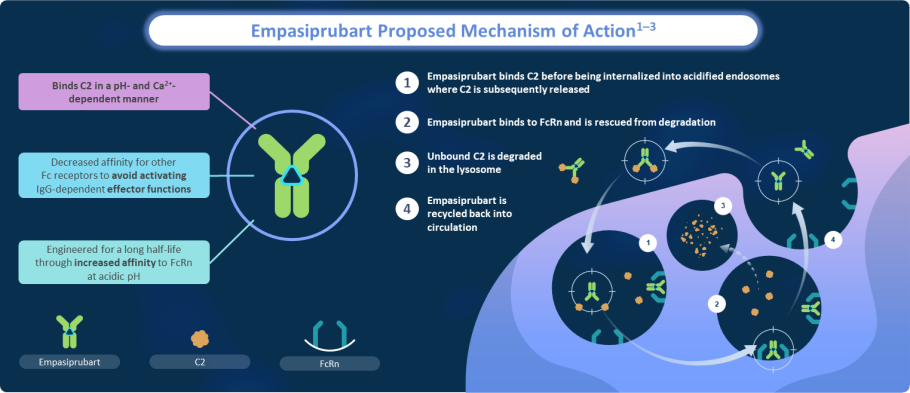
empasiprubart is a differentiated therapeutic mAb targeting C2 equipped with our proprietary NHANCE™ mutations. By addressing a novel target at the intersection of the complement and lectin pathways of the complement cascade, we believe empasiprubart represents a broad pipeline opportunity across several severe autoimmune indications. Activation of the classical and lectin pathway of complement may contribute to tissue damage and organ dysfunction in a number of autoimmune inflammatory diseases and ischemia-reperfusion conditions. Targeting C2 also leaves the alternative pathway of the complement system intact, which is an important component of the innate defense system.
empasiprubart exhibits both pH- and calcium dependent binding. These unique characteristics enable empasiprubart to capture free C2 in circulation and release it in the endosome to be sorted for degradation in the lysosome. empasiprubart is equipped with NHANCE™ mutations increasing its affinity for FcRn and allowing it to recycle back into circulation to capture more C2.
In addition to an IV formulation, we have exclusive access to Halozyme’s ENHANZE® SC drug delivery technology for the C2 target.
1) Van de Walle I, et al. J Allergy Clin Immunol. 2021;147:1420–9.
2) Vaccaro C, et al. Proc Natl Acad Sci. 2006;103:18709–14.
3) Brinkhaus M, et al. Nat Commun. 2022;13:6073.
empasiprubart Indications
MMN
Overview
MMN is a debilitating neuromuscular autoimmune disorder that is characterized by slowly progressive muscle weakness due to motor neuron degeneration. It mainly affects hands and forearms, mainly in males, and the median age of diagnosis is around 40 years. Diagnosis takes about a year and a half and is often misdiagnosed as ALS. There are estimated to be around 12,000 patients across key markets.
Specific pathophysiologic characteristics of MMN include the presence of IgM autoantibodies against the ganglioside GM1 and conduction block, i.e., impaired propagation of action potentials along the axon. GM1 is widely expressed in the nervous system by neurons, particularly around the nodes of Ranvier, and Schwann cells.
IVIg is the only approved treatment for MMN and needs to be dosed frequently to address the disease’s progressive nature.
Phase 2 POC ARDA Clinical Trial
The Phase 2 POC ARDA clinical trial was a randomized, double‑blinded, placebo‑controlled multicenter clinical trial evaluating the safety and tolerability, efficacy, PK, PD, and immunogenicity of two dose regimens of empasiprubart in adults with MMN. Safety and tolerability were the primary endpoint and additional endpoints included time to IVIg retreatment, biomarker analyses of C2 levels, and changes in key functional scores (modified medical research council‑10 sum score, grip strength, MMN‑RODS) as well as several patient‑reported quality‑of‑life measures (fatigue severity score (FSS), chronic acquired polyneuropathy patient‑reported index (CAP‑PRI), and patient global impression change scale). In 2024, argenx announced positive data from the first cohort (n=16), which were confirmed with the second cohort (n=16) in July 2024, establishing POC in MMN, with empasiprubart demonstrating a 91% reduction in the need for IVIg rescue compared to placebo [HR (95% CI)=0.09 (0.02; 0.44)] in cohort 1 and an 84% reduction in IVIg rescue compared to placebo [HR (95% CI)=0.16 (0.02; 1.54)] in cohort 2.
Based on these results argenx initiated the EMPASSION Phase 3 clinical trial evaluating empasiprubart in MMN head to head with IVIg at the end of 2024.
Phase 3 EMPASSION Clinical Trial Design
A Phase 3, randomized, double-blinded, double-dummy clinical trial evaluating the efficacy and safety of empasiprubart versus intravenous immunoglobulin in adults with multifocal motor neuropathy. The clinical trial comprises a screening period of up to 15 weeks, including a minimum of 2 IVIg cycles; a 24-week (6-month), randomized, double-blinded, double-dummy treatment period (part A) evaluating the efficacy and safety of empasiprubart vs IVIg continuation; a 24-month OLE period (part B); and a 15-month safety follow-up period starting after the last dose of IMP. The primary objective is to demonstrate the efficacy of empasiprubart compared to IVIg in improving functional ability. This will be measured by change from baseline in the 25-item MMN-RODS centile score at week 24. Additional key secondary endpoints include changes in measurements on key functional scores (modified medical research council-14 sum score, grip strength) as well as patient-reported quality of life outcome measures (polyneuropathy patient-reported index, and values of the patient global impression change scale and evaluation of manual dexterity using 9HPT.
DGF
Delayed graft function (DGF), defined as the need for dialysis in the first week after kidney transplant, affects up to 40% of deceased‑donor recipients and is associated with poorer long‑term outcomes. Decision for Phase 2 VARVARA clinical trial now expected mid-year 2026 to complete 52-week efficacy analysis
CIDP
Overview
Please refer to Section “1.3.3 efgartigimod Indications” (CIDP) for more information on CIDP.
Phase 3 EMVIGORATE and EMNERGIZE Clinical Trials
argenx is advancing two Phase 3 clinical trials of empasiprubart in CIDP: EMVIGORATE and EMNERGIZE. EMVIGORATE is a head‑to‑head clinical trial comparing empasiprubart to IVIg in adults with CIDP. EMNERGIZE is a randomized, placebo‑controlled clinical trial evaluating the efficacy and safety of empasiprubart. Topline results from both EMVIGORATE and EMNERGIZE are expected in the second half of 2027.