
A long path to diagnosis
At first, Lucille’s doctor thought her numbness and balance issues were being caused by her diabetes. As they continued to get worse, however, they both knew something else was going on. “The doctor would hold on to me and tell me to close my eyes,” she said, “and I just couldn’t stay standing. I’d fall down if he wasn’t holding me up.”
Her doctor wasn’t familiar with CIDP, and he couldn’t figure out what was wrong. So for 5 years, Lucille’s symptoms continued to worsen. Eventually, he referred her to a colleague who happened to be familiar with CIDP and was able to help Lucille finally get the right diagnosis.
“I wish I would have gotten a diagnosis sooner,” she said. Seeing more than one doctor is sometimes necessary to get a CIDP diagnosis. Not all doctors are familiar enough with CIDP to suggest the needed testing.
Diagnosis received, challenge accepted
Being a very determined person, Lucille made the conscious decision to face her diagnosis head-on. Instead of focusing on the condition and how it could limit her, she focused on the many things she wanted to do and how she could limit the impact of CIDP on her lifestyle. She committed to a schedule of regular, ongoing treatments that have enabled her to continue doing the things that give her joy. “CIDP’s not going to get me down, until it actually takes me down,” she said.
Lucille loves to travel. She has a very adventurous spirit, and her travels are not for the faint of heart. Not only has she made it to the top of Machu Picchu since being diagnosed, but she’s also visited Morocco, climbed the Great Pyramid in Giza, Egypt, and flew in a hot air balloon in Turkey, among many other exotic places.
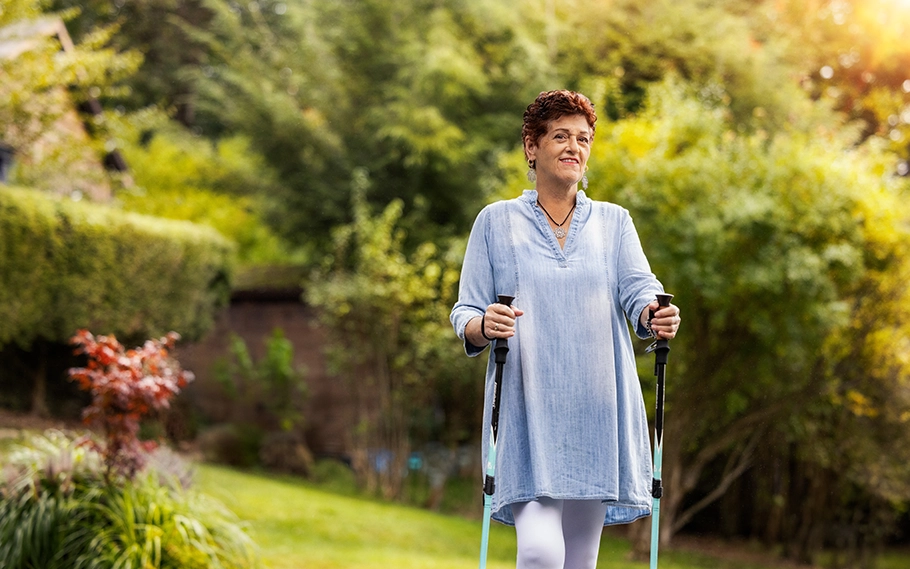
Unlike many people’s vacations, when Lucille travels, there’s no sitting around and taking it easy. That’s not to say CIDP hasn’t affected her abilities. These days, whenever she walks for a distance, she uses walking sticks for balance and support. She also has trouble walking down stairs, due to unsteadiness in her legs.
These CIDP symptoms may have slowed her down, but they haven’t defeated her. Lucille has been able to manage her symptoms and keep moving with the help of caregivers, which include her children and her siblings.
While traveling with her son in England, the two walked over 49 miles, despite Lucille falling on day 2. “My son helps me a lot. He knows that I can get tired. He knows that if I'm walking down stairs, to be in front of me so that I don't fall down the stairs.”
Lucille recognizes the importance of a good support system. In addition to her son and siblings, with whom she’s very close, she also has a group of longtime friends and a loving support dog she can depend on for help and comfort.
Because she’s so focused on doing what she loves, though, she often forgets about CIDP and the fact that her legs are weaker than they used to be. “I need to remind myself that, even though I’m not letting CIDP stop me, I still need to be careful and take my walking sticks or a cane with me,” she said.
When hiking, “I may be the last person in the group to make it to the destination,” she said, “but I’m never far behind.” Hiking down a mountain in Peru was a difficult and scary adventure, but she set her sights on the goal and forged ahead. “I wasn’t going to give in to fear.”
When CIDP symptoms start to get her down, Lucille’s confidence helps her get through. “To live with CIDP, I have to push through each day—bad days as well as good ones.”
Lucille sums up her experience by saying, “As much as I can, I try to keep doing the things I love to do, even though I have CIDP.” She knows that’s not always possible, but that doesn’t stop her from living life on her terms. She already has several more adventures planned, including a canoe trip down the Amazon River.